MOE just changed P1 registration: what it means if you are buying a home for a school
Two changes, announced 10 September 2026. Phase 2C gets 50% bigger at most schools. And at 12 named schools — almost all of them in the most expensive residential pockets in Singapore — living closer stops moving you up the queue. Here is what actually changed, and what it does to the 1km premium.
Applies from the 2027 exercise — children entering P1 in Jan 2028.
The short version. On 10 September 2026 MOE announced two changes to Primary One registration, both starting with the 2027 Registration Exercise — that is, for children entering P1 in January 2028.
One. The places each school holds back for Phase 2C rise from 40 to 60. Schools with fewer than 180 P1 places keep 40. Phase 2B stays at 20. The extra 20 places come out of the earlier phases.
Two. At 12 named schools, Phase 2C splits into two equal tracks — one for families living within 2km, one for families beyond 2km — and inside each track there is no home-school distance priority at all. A family 400m away and a family 1.9km away have exactly the same chance in the ballot.
I am a property agent, not an education reporter, so let me be upfront about which part of this I am qualified to talk about. The rules themselves are MOE’s and I have linked them at the bottom. What I can tell you about is the thing my clients actually ask me: does this change what a home near a good school is worth?
Short answer, and I will defend it below: at 12 addresses in Singapore, yes, a little, and in a very specific way. Everywhere else, no.
40 → 60
Phase 2C reserved places
12
Schools on two-track Phase 2C
2027
Exercise it starts with
Jan 2028
First P1 cohort affected
Change one
Phase 2C gets 50% bigger
Every primary school holds back a pool of places so it cannot be filled entirely by siblings, alumni and volunteers before the open phase begins. Until now that pool was 20 for Phase 2B and 40 for Phase 2C, 60 in total. From the 2027 exercise the Phase 2C half becomes 60, taking the reserved pool to 80.
Two caveats that matter and get lost in the headlines. Schools with fewer than 180 P1 places keep 40, because reserving 60 out of a small intake would squeeze the earlier phases too hard. And the extra 20 places are not new places — they come out of the earlier phases. Phase 2C gains what Phases 1, 2A and 2B give up.
Reserved places per school, before and after · Source: MOE press release, 10 Sep 2026
Swipe to see both columns →
Change two
The two-track scheme, and why it is the bigger story
This is the one that matters for property. At 12 named schools, Phase 2C is split into two equal tracks by a single 2km line, and within each track, distance stops counting entirely.
Under the old rules, Phase 2C worked down a graded queue: citizens within 1km, then citizens 1–2km, then citizens beyond 2km, then PRs in the same three bands. Under the two-track scheme at these schools, there is no graded queue. There is a 2km line, two pools of places, and a ballot inside each pool if it is oversubscribed.
How two-track Phase 2C works at the 12 named schools · Source: MOE press release, 10 Sep 2026. Place counts shown for a school with 60 reserved Phase 2C places.
Swipe to see the full diagram →
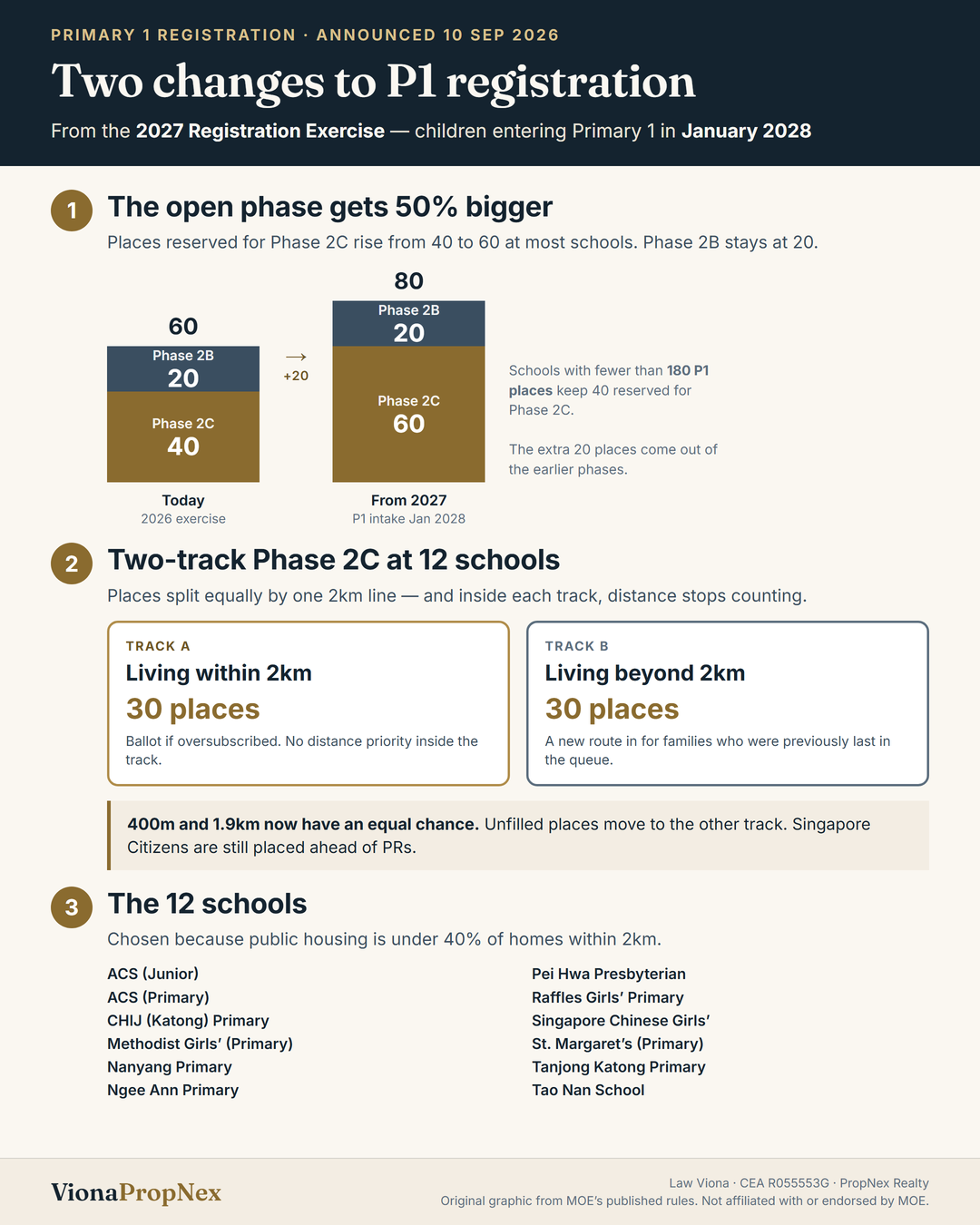
Save this
Both changes on one card
I made this to be saved and forwarded — it is sized for WhatsApp and Instagram. Original graphic, built from the published rules. If you would rather have MOE’s own version, it is linked in the sources at the bottom of this page.

The list
The 12 schools, and what they have in common
MOE picked these 12 on one criterion: public housing accounts for less than 40% of dwelling units within 2km of the school. Read that sentence again with a property agent’s eyes and you have the whole story. These are the twelve schools sitting in Singapore’s most private-housing-dominated pockets.
The 12 schools on the two-track list · Source: MOE press release Annex, 10 Sep 2026. Area groupings are my own reading, not MOE’s.
| Area | Schools | Count |
|---|---|---|
| Bukit Timah, Newton and Dunearn broadly D10, D11, D21 | Anglo-Chinese School (Junior) · Anglo-Chinese School (Primary) · Methodist Girls’ School (Primary) · Nanyang Primary School · Pei Hwa Presbyterian Primary School · Raffles Girls’ Primary School · Singapore Chinese Girls’ Primary School | 7 |
| Katong and Marine Parade broadly D15 | CHIJ (Katong) Primary · Ngee Ann Primary School · Tanjong Katong Primary School · Tao Nan School | 4 |
| City fringe broadly D9 | St. Margaret’s School (Primary) | 1 |
| Total | Every one of them sits in a pocket where private housing dominates within 2km. | 12 |
Swipe to see the full list →
Why this list and not another
MOE’s reasoning is straightforward and, I think, hard to argue with on its own terms. Home-school distance priority exists to connect schools to their neighbourhoods. But if a school’s 2km neighbourhood is 80% private housing, then distance priority does not broaden access — it narrows it, because the only families who can use it are the ones who could afford to buy in. MOE’s own framing is that some schools have a narrower socio-economic mix that simply reflects the profile of their immediate neighbourhood, and that distance priority does not fix that in those places.
Whether you agree with the policy is a separate question from whether it changes your buying decision. It does, and here is how.
The property read
What this does to the 1km premium
Let me be careful here, because this is the part where property commentary usually overreaches in both directions. You will read “the 1km rule is dead” this week. You will also read “nothing has changed.” Both are wrong.
What genuinely changed
- At those 12 schools, in Phase 2C, the graded distance advantage is gone. 400m and 1.9km are now identical. If you were paying a premium for being very close rather than merely close, that specific premium no longer buys you anything in the open phase.
- Living beyond 2km became a real route in. Previously a family 5km away was at the back of the Phase 2C queue at Nanyang or Tao Nan. Now they have a reserved pool of roughly 30 places that nobody nearer can touch.
- The open phase is 50% bigger nearly everywhere. 60 reserved places instead of 40 improves the odds for every family without a prior connection, at almost every school in Singapore.
What did not change
- The 2km line still decides your track. Being inside 2km is still worth something concrete at those 12 schools — it puts you in Track A. It is a cliff now rather than a slope, but the cliff is real.
- Phases 2A and 2B are untouched. Alumni, sibling and volunteer routes still work exactly as before, and distance still orders those queues.
- Nothing changed at the other ~170 primary schools. Citizens within 1km still come before citizens 1–2km, who still come before citizens beyond 2km. If you are buying near a school that is not on the list of 12, your plan is intact.
- The 30-month stay rule still applies where the place came through a distance category.
My honest read, in one paragraph
The change is real but narrow, and it has been mis-sized in both directions this week. For eleven-twelfths of Singapore’s primary schools, the “buy inside 1km” logic is exactly as strong as it was on 9 September — and slightly better, because the open phase grew. For the twelve on the list, one particular argument has been retired: the idea that 600m beats 1.7km. It does not any more, in Phase 2C. What still holds at those schools is that 1.9km beats 2.1km, which is a strange and very sharp line for a market to price, and I expect some genuinely odd valuation behaviour right at that boundary over the next two years.
If you are mid-search right now for a home near one of the 12, the practical consequence is this: stop paying for metres and start checking the boundary. The question is no longer “how close can I get?” It is “am I inside 2km, yes or no?” That is a much cheaper question to answer, and it opens up addresses you may have written off as too far.
And one caution I will repeat as often as it takes: MOE does not publish how it measures home-school distance. It assigns a category from your NRIC-registered address and tells you to verify it on SLA’s OneMap School Query. Our 1km primary school check measures a straight line, which is useful for shortlisting and is not the official answer. With a 2km cliff now doing this much work at 12 schools, checking the official category before you commit to a purchase has gone from sensible to essential.
In under a minute
The whole thing, as a narrated explainer
I made this to send to clients and to put on YouTube. It is an original animation built from the published rules — not MOE’s video, and not affiliated with MOE. If you want the official one, it is linked in the sources at the bottom.
Action
What I would do, depending on who you are
- You are house-hunting near one of the 12 and your child registers in 2027 or later. Widen the search. The premium for being extremely close has lost its Phase 2C justification, and anything inside 2km now does the same job. Verify the boundary on OneMap before you commit, not after.
- You already own inside 1km of one of the 12. Do nothing. You still have Track A, you still have Phases 2A and 2B if you qualify, and the 2km line still protects you against the wider field. What you have lost is an edge over neighbours slightly further out than you, which was never the reason the home was worth what it is.
- You live beyond 2km and had written these schools off. Re-open the conversation. There is now a reserved pool of roughly 30 places per school that only families like yours can use. That is a materially better chance than you had a week ago.
- You are buying near any other primary school. Nothing has changed for you, and Phase 2C got bigger. Carry on, and use the extra 20 places as a small tailwind rather than a reason to relax about the 1km check.
- Your child registers in the 2026 exercise. None of this applies to you. The 2026 exercise ran under the old rules.
- You were about to join an alumni association or start volunteering. Still worth it. Phases 2A and 2B were not touched, and they remain the most reliable routes into an oversubscribed school. If anything, with more families now able to reach Phase 2C at these 12, getting in before Phase 2C matters slightly more.
Still open
What is not yet settled
The press release answers less than it looks like it does. These are the things I will be chasing, and I will update this page and the P1 guide as each is answered.
1. Whether all 12 schools actually get 60 places
The 40-to-60 increase excludes schools with fewer than 180 P1 places. MOE has not published, in this release, which of the 12 fall under that threshold. At a school that keeps 40, the two tracks would be 20 and 20, not 30 and 30. That materially changes the odds, and it is the first thing I want confirmed.
2. Whether the PR cap list changes
A handful of schools carry a cap on PR intake in Phases 2C and 2C Supplementary, at roughly 25% to 30% of planned P1 intake. For the 2026 exercise those were Bukit Timah Primary, Cantonment Primary and Opera Estate Primary. Whether that list moves now that Phase 2C is bigger, and how the cap interacts with two tracks, is unaddressed.
3. How Phase 2C Supplementary works at the 12
The release does not mention Phase 2C Supplementary. Whether the two-track split carries into it, or whether it reverts to the normal distance ordering, is unclear.
4. What it does to Phase 2A odds
The extra 20 places come out of the earlier phases. At a heavily oversubscribed school, Phase 2A alumni demand already exceeds supply, so taking places out of that pool tightens a queue that was already tight. Nobody has quantified this yet.
5. Whether the market reprices the 2km boundary
This is my own question rather than MOE’s. A hard cliff at exactly 2km, at twelve of the most expensive addresses in Singapore, is the kind of rule that creates a visible price step in the data. I will be watching transactions either side of that line through 2027.
Questions people are asking me this week
Two things. Reserved Phase 2C places rise from 40 to 60 at most schools — schools with fewer than 180 P1 places keep 40, and Phase 2B stays at 20. And 12 named schools move to a two-track Phase 2C, splitting places equally between families within 2km and families beyond 2km, with no distance priority inside either track. Both start with the 2027 Registration Exercise, for children entering P1 in January 2028.
Anglo-Chinese School (Junior), Anglo-Chinese School (Primary), CHIJ (Katong) Primary, Methodist Girls’ School (Primary), Nanyang Primary School, Ngee Ann Primary School, Pei Hwa Presbyterian Primary School, Raffles Girls’ Primary School, Singapore Chinese Girls’ Primary School, St. Margaret’s School (Primary), Tanjong Katong Primary School and Tao Nan School. MOE chose them because public housing makes up less than 40% of dwelling units within 2km.
At most schools yes, and nothing changed. At the 12 on the list it is much weaker in Phase 2C, because inside each track distance no longer counts — 400m and 1.9km are equal. Being within 2km still decides your track, so proximity is not irrelevant, but the graded advantage of being under 1km has gone in that phase at those schools. Distance still applies normally in Phases 2A and 2B, and at every school not on the list.
From the 2027 P1 Registration Exercise, which places children starting Primary One in January 2028. The 2026 exercise, for children entering P1 in 2027, ran under the existing rules and is unaffected.
Phase 2C places are split equally into a within-2km track and a beyond-2km track. If Singapore Citizen applicants in a track exceed its places, MOE ballots within that track, with no distance ordering. If a track does not fill, its spare places go to Singapore Citizen applicants in the other track. Citizens are still placed ahead of PRs in both tracks, and families eligible for Phases 2A and 2B are still placed before Phase 2C begins.
My read: a real but narrow effect. It retires one specific argument for paying a premium — that being 600m away beats being 1.7km away — at 12 schools, in one phase. It leaves the 2km boundary doing a lot of work, which I expect to show up as an unusually sharp price step right at that line. It does not touch Phases 2A and 2B, and it does not affect any other school. This is general commentary, not financial advice.
Yes. Phases 2A and 2B were not changed, and they are still the most reliable way into an oversubscribed school. Note the timing has not changed either: Phase 2B volunteering means joining by 1 July of the year before registration and completing 40 hours by 30 June of the registration year, so it starts roughly two years ahead. One nuance — the extra 20 Phase 2C places come out of the earlier phases, so those queues get slightly tighter, not looser.
Buying near a school? Let me check the boundary before you commit.
Tell me the school and the address you are looking at. I will tell you which side of the 2km line it sits on, which phase you realistically qualify for, and whether the price you are being asked reflects a rule that still exists. If the honest answer is that the premium no longer makes sense, I will say so.
Sources and dates
The rules on this page are MOE’s, restated in my own words. The property analysis and the area groupings are mine and are labelled as such. Figures were correct on 11 September 2026.
- Ministry of Education, press release, “Enhancing the Primary One Registration Framework for Greater Access and Inclusivity”, 10 September 2026 — the 40-to-60 increase in reserved Phase 2C places, Phase 2B unchanged at 20, the extra places coming from the earlier registration phases, the two-track scheme, the under-40% public housing criterion, the equal split between tracks, balloting within a track, spare places flowing to the other track, citizens retaining priority over PRs, and MOE’s commitment to review the school list periodically.
- MOE’s official infographic and explainer video for these changes, published 10 September 2026: go.gov.sg/p1changesinfographic and go.gov.sg/p1changesvideo. The graphics and the video on this page are my own original work, made from the published rules; they are not MOE’s and are not endorsed by MOE.
- Singapore news coverage of the announcement, 10–11 September 2026 — the list of 12 schools, the exception for schools with fewer than 180 P1 places, and Education Minister Desmond Lee’s remark that parents value a school near home, particularly for young children, and that MOE had reached broad agreement with stakeholders.
- Existing framework details carried over from MOE’s registration pages as at 7 September 2026 — the phase structure, Phase 2B volunteering thresholds (joining by 1 July of the year before, 40 hours by 30 June of the registration year), the 30-month stay requirement where a place came via a distance category, and the PR cap of roughly 25% to 30% of planned P1 intake in Phases 2C and 2C Supplementary, which applied to Bukit Timah Primary, Cantonment Primary and Opera Estate Primary in the 2026 exercise.
- My own analysis, not reported fact — the grouping of the 12 schools by residential area and district, the reading that the change retires the graded sub-1km premium while sharpening the 2km boundary, the expectation of a visible price step either side of 2km, and every recommendation in the action section.
- On measuring distance. MOE does not publish its method for measuring home-school distance. It assigns a category from the parents’ NRIC-registered address and directs parents to SLA’s OneMap School Query for the official result. Our own tool measures a straight line and is for shortlisting only. Always confirm the official category before making a purchase decision.
This article is general commentary on a public policy announcement. It is not financial advice, it is not legal advice, and it is not a representation about any specific property or any child’s chance of admission. VionaPropnex is not affiliated with, endorsed by, or speaking for the Ministry of Education. For the authoritative rules, always use MOE’s own pages.